
Written by Plastic Surgeon, Dr. Nerina Wilkinson
There is a moment many of us recognise. We look in the mirror and sense that something has changed, yet we cannot quite explain what it is. Perhaps the eyes seem more tired, the cheeks a little flatter, the jawline less defined or the skin less luminous. We focus on the most visible clue – a wrinkle, fold or hollow – and assume that this is what is making us look older.
Table of contents
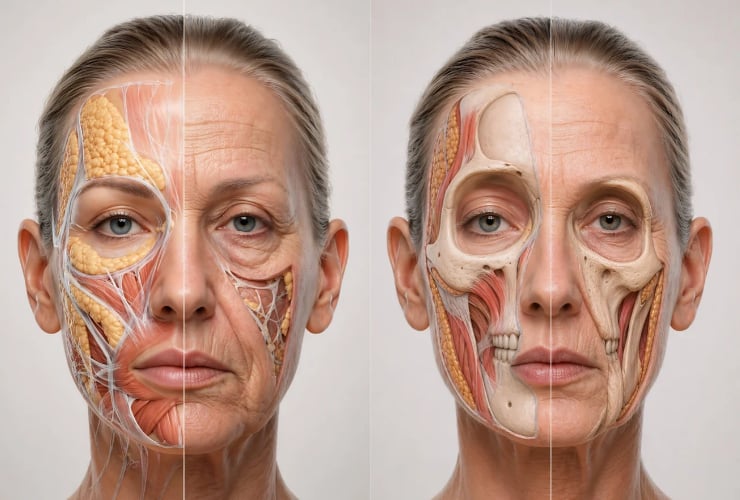
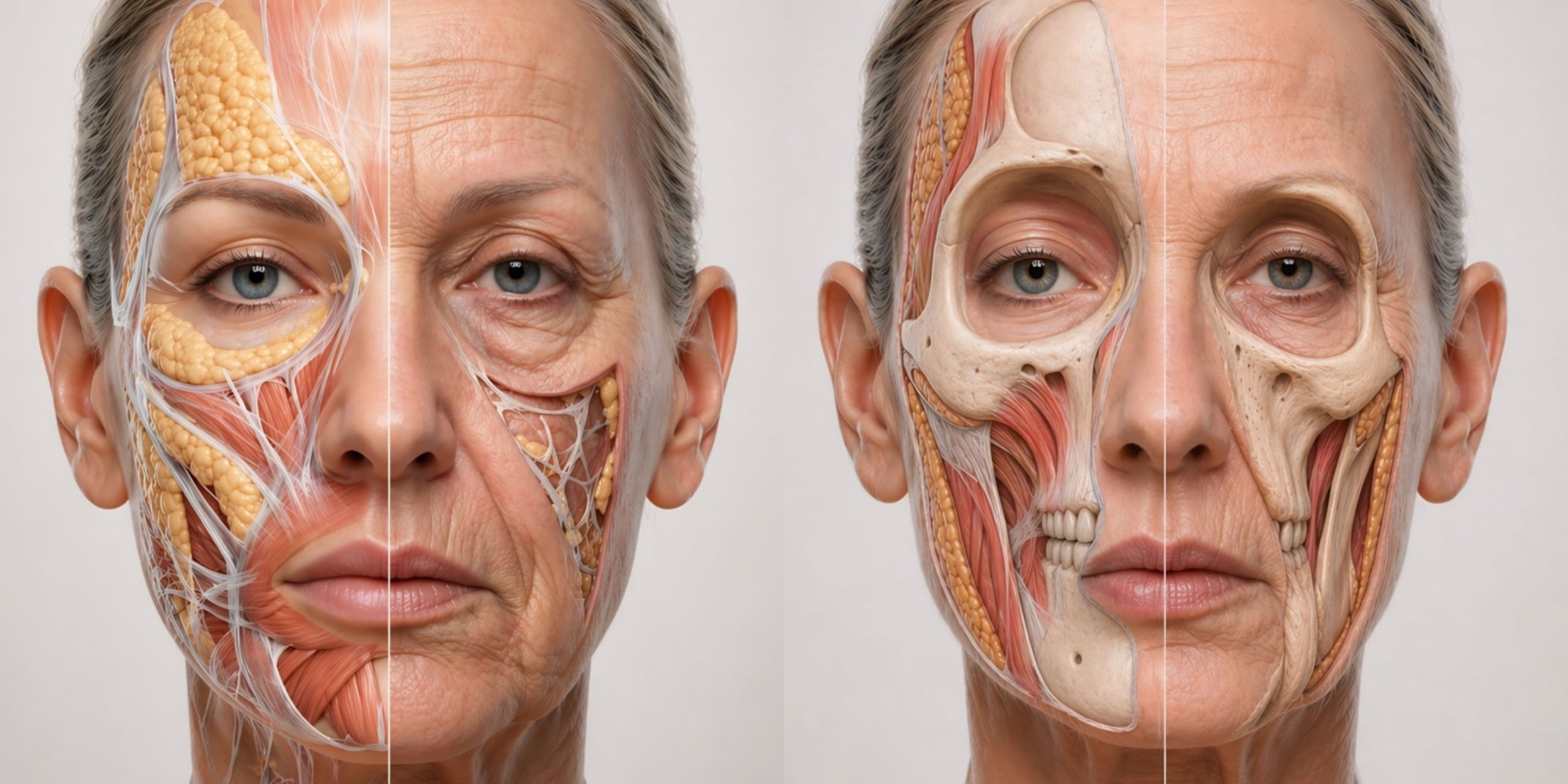
But the face does not age wrinkle by wrinkle. Facial ageing is a three-dimensional process involving the skin, fat, muscles, ligaments and facial skeleton. These layers are beautifully interconnected, and each changes at its own pace. This is why two people of the same age may look entirely different, and why treating one visible line rarely addresses the full story.
Understanding how the face ages allows us to move away from chasing imperfections and towards something far more considered: preserving harmony, supporting tissue health and creating a personalised plan for Intelligent Ageing.
Why Understanding Facial Ageing Matters
When a patient tells me, ‘I don’t look like myself anymore,’ she is often not describing one isolated wrinkle. She may be noticing a shift in the overall balance of her face: a change in proportion, softness, light and shadow, or the way the tissues frame her eyes and mouth. A wrinkle, hollow, jowl or tired appearance is therefore an observation, not yet a diagnosis.
The same visible concern can have very different underlying causes. A hollow beneath the eye may involve facial volume loss, skin thinning, ligament anatomy, skeletal support or several of these factors together. A fold beside the mouth may be influenced by changes in the cheek above it rather than by the fold alone. This is why a thoughtful facial assessment matters. It does not mean that every layer must be treated; in fact, understanding more often allows us to do less, more precisely.
A comprehensive approach is not about adding more treatments. It is about understanding more before deciding what is genuinely needed.
Facial Ageing and the House Analogy
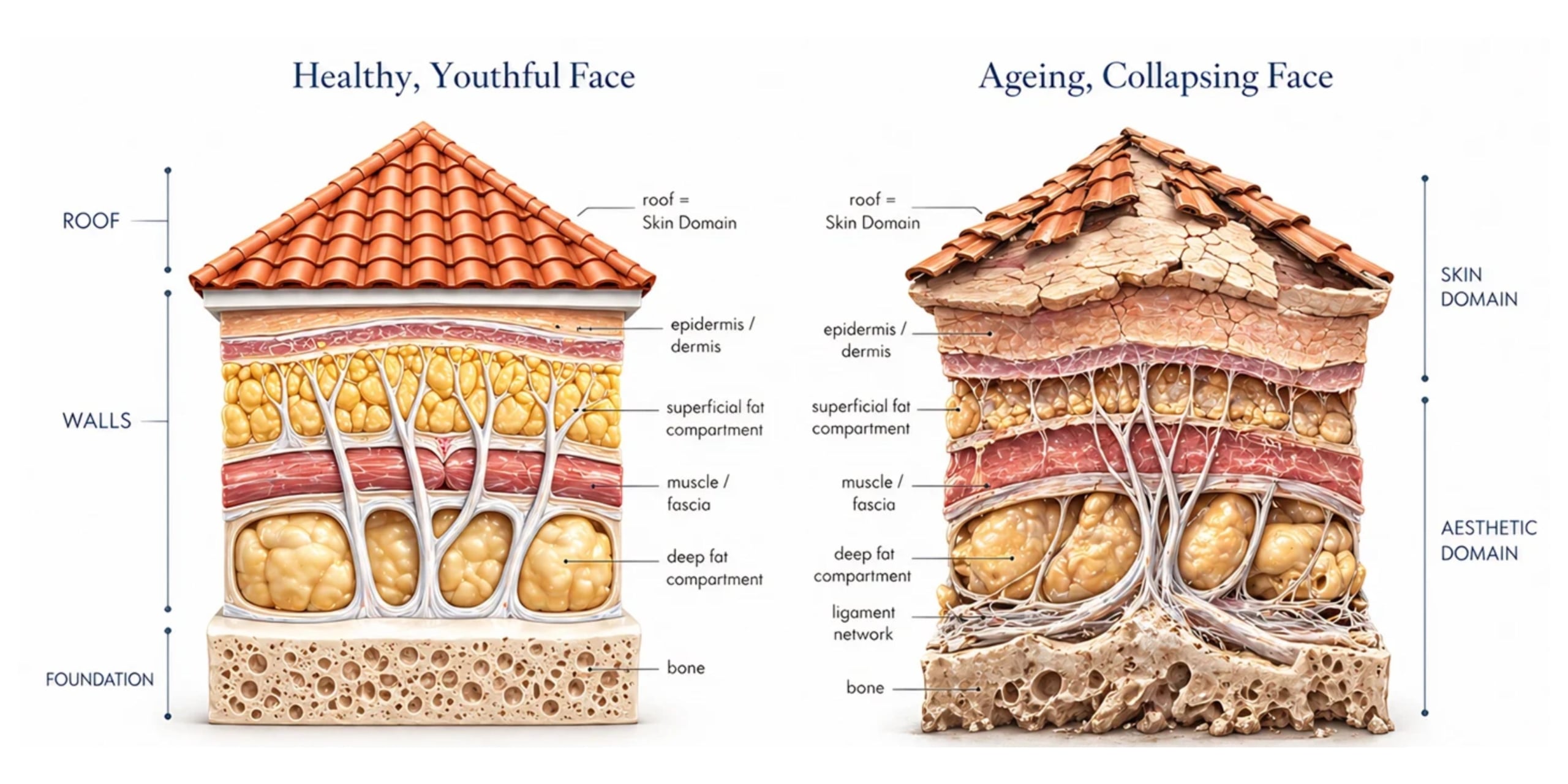
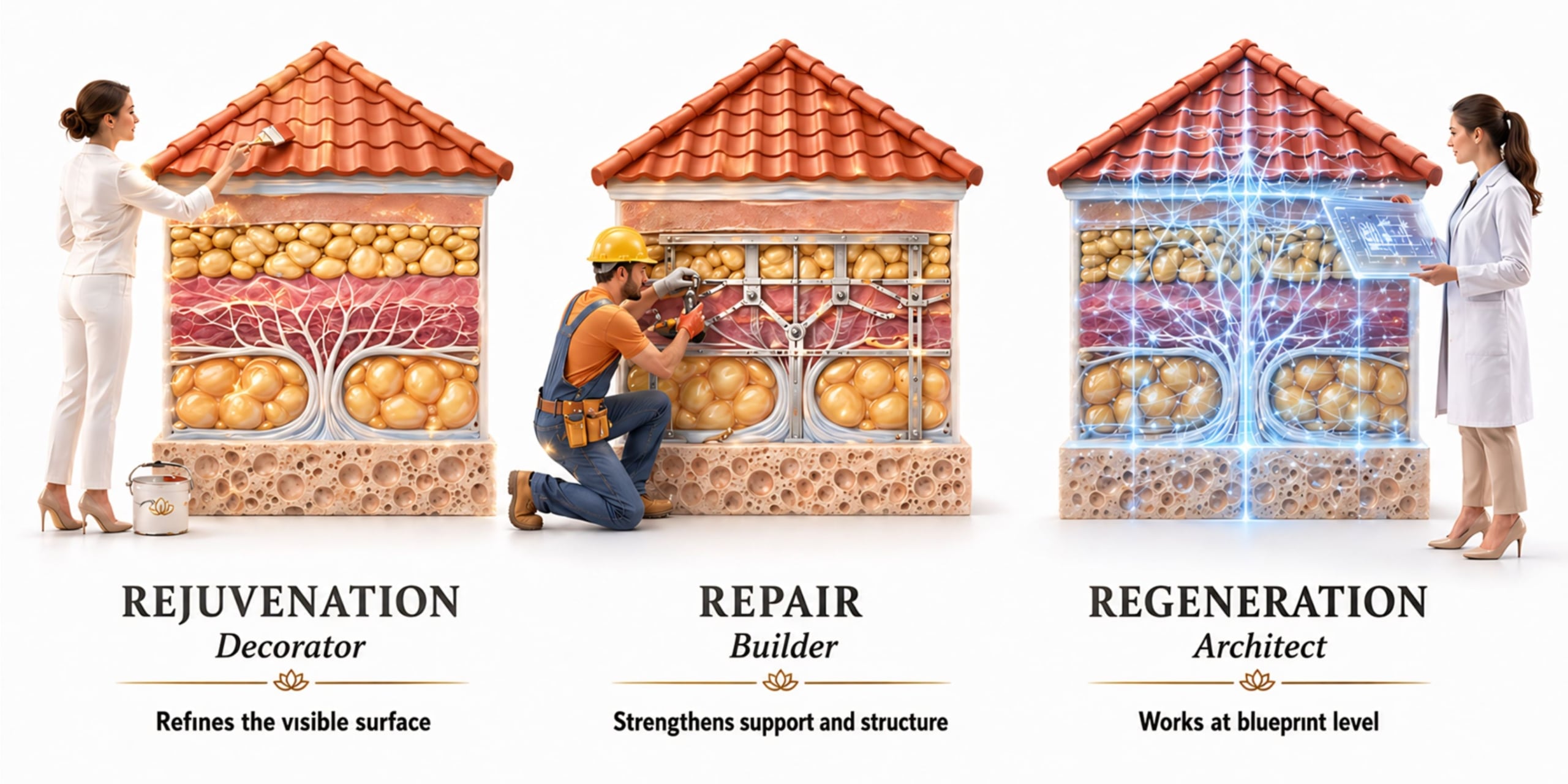
One of the simplest ways to understand facial ageing is to imagine the face as a house. A house is not defined by its paintwork alone. It depends on its foundation, framework, internal volume and roof. If the foundation changes, the structures above it may shift, and even the most beautiful roof cannot fully compensate for changes beneath it.
The face works in much the same way. The facial skeleton creates the foundation. Fat provides softness, volume and smooth transitions. Muscles and ligaments form part of the moving and supporting framework. The skin is the visible roof – the layer we see and touch, but also the layer that reflects what is happening below.
This analogy is helpful because it reminds us that a treatment can be excellent and still disappoint if it is directed at the wrong layer. Resurfacing may improve the roof beautifully, but it cannot rebuild lost support. Adding volume may soften a hollow, but it cannot always reposition a wall that has shifted. A surgical lift may restore structure, yet it does not replace the need to care for pigmentation, texture and skin health.
The Foundation: Facial Bone
We seldom think about bone when we look at an ageing face, yet the facial skeleton plays an essential role in shape, projection and support. Bone is living tissue, and gradual remodelling can alter the framework around the eyes, cheeks, jaw and chin. These changes may contribute to greater hollowing around the eyes, flattening through the midface, deeper shadows and less definition along the jawline.
Not every sign of facial ageing is caused by bone, and not every patient needs structural treatment. The point is simply that the skin surface cannot always correct a change beginning much deeper. When the foundation changes, the architecture above it may change too, which is why repeated surface treatment may improve skin quality without fully addressing the patient’s sense that her face has lost support.
Facial Fat: Softness, Support and Light Reflection
Facial fat is often misunderstood. We tend to imagine one continuous layer that gradually disappears, but facial fat is organised into distinct compartments positioned at different depths. These compartments behave differently over time. Some lose volume, while others change shape or position. An area may also look heavier because the tissue beside or above it has become depleted.
Fat gives the face far more than fullness. It creates softness, supports elegant transitions between features and influences how light moves across the face. When those transitions are disrupted, we see stronger shadowing, hollowness and separation between facial areas. A woman may therefore look tired even when she has very few wrinkles, because what she is noticing is a change in three-dimensional contour rather than a change on the surface alone.
It is particularly important to distinguish between deflation and descent. Deflation means that volume has been lost; descent means that tissue has shifted downwards. A patient may have one, the other or both. If descended tissue is repeatedly treated as though it were simply empty, excessive volume can create heaviness rather than rejuvenation. The goal is never fullness for its own sake. Volume should be restored selectively, in the correct layer and only where it has genuinely been lost.
Muscles, Ligaments and the Supporting Framework
The face moves with every smile, frown and expression. Repeated movement contributes to dynamic wrinkles, while facial ligaments help anchor soft tissues to deeper structures. As the surrounding tissues change, the face may gradually lose some of its earlier support and definition, contributing to deeper folds, softening of the jawline, jowling and changes around the mouth.
Different treatments have different functions. A treatment that relaxes muscle movement does not restore lost volume. A treatment that replaces volume does not necessarily reposition descended tissue. A treatment that improves the skin cannot correct every structural change beneath it. When deeper tissues have shifted significantly, surgery may eventually be more anatomically appropriate than continuing to add temporary volume.
Honest aesthetic medicine includes recognising not only what a treatment can do, but also what it cannot.
The Skin: Our Visible Roof
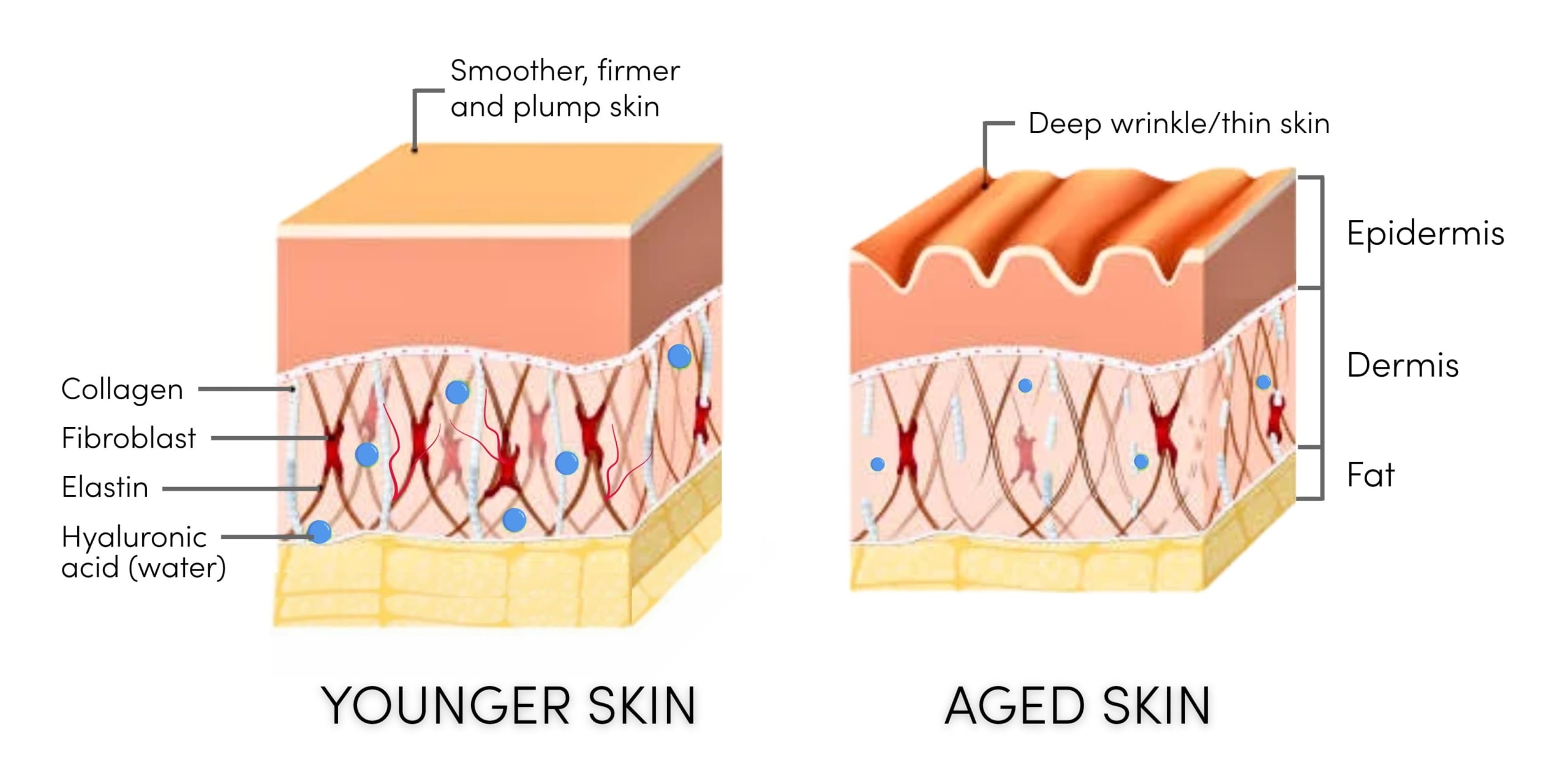
The skin is the layer we notice first. It reflects light, frames our features and plays an enormous role in whether a face appears fresh, healthy and vibrant. Yet skin ageing is far more complex than the development of fine lines. With age, the skin changes in collagen, elastin, hydration and cellular function. Ultraviolet exposure accelerates wrinkles, uneven pigmentation and photoageing, while hormonal change, inflammation, smoking, stress and environmental exposure influence the way the skin repairs.
Beautiful skin quality includes luminosity, even tone, smooth texture, hydration, elasticity, firmness, barrier health and resilience. Collagen contributes to the strength of the dermis, but it is only one part of a living system. Treating the skin is therefore an essential part of facial rejuvenation, yet even beautifully resurfaced skin cannot fully correct facial volume loss, altered support or significant tissue descent.
In the same way, restoring volume without caring for the skin may improve contour while leaving the face lacking radiance and vitality. Natural rejuvenation respects both the surface and the structures beneath it.
Why Wrinkles Are Only One Piece of the Ageing Story
Wrinkles are real, and they can certainly influence how we feel about our appearance. However, they are usually a visible consequence of several deeper changes rather than the cause of facial ageing itself. A line may be influenced by repeated movement, collagen loss, thinner or drier skin, changes in the underlying fat, reduced skeletal support, ligamentous tethering, tissue descent and cumulative sun damage.
Consider a fold beside the mouth. It may deepen partly because of changes in the cheek above it. A hollow beneath the eye may involve skin quality, fat distribution, ligament anatomy, skeletal support and shadowing. A jowl may reflect tissue descent and altered support rather than a simple lack of volume. Treating only the visible line may therefore leave the wider facial imbalance unchanged.
Wrinkles are part of the ageing story, but they are rarely the whole story.
The Role of Regenerative Aesthetics in Intelligent Ageing
For many years, aesthetic medicine focused predominantly on correcting what could be seen: filling a hollow, relaxing a wrinkle, resurfacing the skin or tightening tissue. These treatments remain extremely valuable. Regenerative aesthetics simply introduces an additional question: can we also support the health, function and quality of the tissue itself?
Regenerative and biostimulatory approaches may support repair, collagen production, cellular signalling or the use of a patient’s own tissue. They do not replace carefully performed injectables, energy-based treatments or surgery, and the scientific evidence supporting different therapies continues to evolve. The future lies in understanding which layer requires attention and then selecting the most appropriate tool – whether that is medical skincare, collagen stimulation, regenerative support, selective volume restoration, muscle balancing, an energy-based treatment or surgery.
Intelligent Ageing is not about trying to remain frozen at one age. It is a long-term philosophy based on understanding individual biology, protecting what is healthy and intervening thoughtfully when change begins. Prevention may mean daily sun protection, evidence-based skincare, avoiding smoking, supporting the skin barrier and addressing pigmentation or inflammation early. It may also mean recognising when a small, carefully planned intervention is wiser than waiting until correction becomes complex, and when doing nothing is the most respectful choice.
The Importance of Preserving Identity in Aesthetics
Every face has its own ageing blueprint. Genetics, facial shape, bone structure, fat distribution, skin quality, hormonal stage, sun exposure, health, lifestyle and previous treatments all influence how ageing appears. A personalised treatment plan must also consider the person behind the face: what concerns her most, what she wishes to preserve, how much downtime is realistic and whether she prefers gradual change or a more definitive result.
A comprehensive plan does not mean that every patient requires every available treatment. Sometimes the most intelligent recommendation is to treat the skin first. Sometimes it is to restore a small amount of lost support, combine regenerative care with structural treatment or consider surgery when repeated camouflage is no longer honest. Sometimes it is simply to wait.
The future of aesthetics will not be defined by one miraculous device, injectable or surgical technique. It will be defined by better understanding. The goal is not to chase every wrinkle or force the face back to an earlier version of itself, but to protect what is healthy, restore what has genuinely been lost and support the face as it continues to age. That is the essence of Intelligent Ageing: ageing with knowledge, intention and respect for the individual.

Frequently Asked Questions
At what age does facial ageing begin?
Facial ageing is gradual, although visible changes vary greatly. Genetics, sun exposure, lifestyle, anatomy and hormonal changes all influence when they become noticeable.
Why does my face look tired even when I don’t have wrinkles?
A tired appearance may come from shadowing, under-eye hollowing, facial volume loss, skin quality or changes in tissue support, rather than wrinkles alone.
Can skincare products prevent facial ageing?
Skincare cannot prevent every structural aspect of ageing, but it can protect against ultraviolet damage, support barrier health, improve hydration and reduce visible skin ageing. Daily sun protection remains one of the most valuable preventive measures.
Can facial volume loss only be treated with filler?
No. The best approach depends on the cause, location and extent of the change. Options may include no treatment, carefully placed filler, collagen stimulation, fat grafting, regenerative support or surgery.
Can one treatment address every layer of the face?
No single treatment can reliably correct skin damage, muscle activity, facial volume loss and significant tissue descent at the same time. A personalised plan may use one carefully selected treatment or a thoughtful combination.
Interested in your own Intelligent Ageing plan? Email us at capetown@drnwilkinson.co.za to start your journey today.